#P HF/STO-3G scf=tight pop=full gfinput HF/STO-3G//HF/STO-3G sp formaldehyde 0 1 C1 O2 1 r2 H3 1 r3 2 a3 H4 1 r3 2 a3 3 180.0 r2=1.21672286 r3=1.10137241 a3=122.73666566 | ![]() |

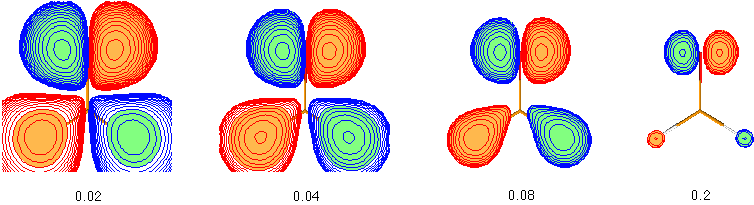
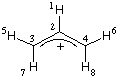
#P HF/6-31G(d) cube=orbitals scf=(tight) HF/6-31G(d) HOMO allyl cation + generation of cube-file +1 1 H,0,0.,0.,-1.5682867937 C,0,0.,0.,-0.4948409695 C,0,1.1776939788,0.,0.2112484936 C,0,-1.1776939788,0.,0.2112484936 H,0,2.1316522244,0.,-0.2859258635 H,0,1.1894473911,0.,1.2871012074 H,0,-2.1316522244,0.,-0.2859258635 H,0,-1.1894473911,0.,1.2871012074 mycubefile_HOMO.cub 11 | ![]() |
#!/bin/csh
#PBS -l mem=128mb
#PBS -q long
setenv g03root /usr/local
setenv GAUSS_SCRDIR /scratch
setenv GAUSS_EXEDIR /usr/local/g03b3
setenv GAUSS_ARCHDIR /usr/local/g03b3
setenv LD_LIBRARY_PATH "${GAUSS_EXEDIR}:/usr/lib"
cat >$GAUSS_SCRDIR/$PBS_JOBNAME << EOF
%chk=/scratch/allyl.chk
%mem=6000000
#P HF/6-31G(d) scf=(tight) formcheck
HF/6-31G(d) HOMO allyl cation + generation of cube-file
+1 1
H,0,0.,0.,-1.5682867937
C,0,0.,0.,-0.4948409695
C,0,1.1776939788,0.,0.2112484936
C,0,-1.1776939788,0.,0.2112484936
H,0,2.1316522244,0.,-0.2859258635
H,0,1.1894473911,0.,1.2871012074
H,0,-2.1316522244,0.,-0.2859258635
H,0,-1.1894473911,0.,1.2871012074
EOF
touch $PBS_O_WORKDIR/$PBS_JOBNAME.$HOST
/usr/local/g03b3/g03 < $GAUSS_SCRDIR/$PBS_JOBNAME > $GAUSS_SCRDIR/$PBS_JOBNAME.log
mv $GAUSS_SCRDIR/$PBS_JOBNAME.log $PBS_O_WORKDIR/$PBS_JOBNAME.log
mv $GAUSS_SCRDIR/$PBS_JOBNAME.chk $PBS_O_WORKDIR/$PBS_JOBNAME.chk
rm -f $GAUSS_SCRDIR/$PBS_JOBNAME
mv Test.FChk $PBS_O_WORKDIR/$PBS_JOBNAME.fch
$GAUSS_EXEDIR/cubegen 0 MO=11 $PBS_O_WORKDIR/$PBS_JOBNAME.fch $PBS_O_WORKDIR/$PBS_JOBNAME.cub 0 h
exit
What the additional lines after execution of Gaussian do is move the Gaussian
output files from /scratch to the users working directory, move the formatted checkpoint file
named "Test.FChk" to a more meaningful name (here: allyl.fch), and then call
cubegen to generate the cube file for molecular orbital 11.
This latter program accepts six arguments on the command line. The first argument (here: 0)
defines the memory allocated to the run. Using the argument of 0 specifies automatic
memory allocation. The second argument defines the type of cube plot desired in this run.
The particular argument here (MO=11) defines the molecular orbital 11, other numbers indicating
other orbitals. The third argument defines the name of the formatted checkpoint file,
the fourth argument the name of the cube file, the fifth argument the number of points
per side of the cube. Using the argument of 0 at this point again leads to automatic selection
of sensible defaults. Finally, the last argument indicates, whether a header (h) is to be included
in the cube file. If this is not desired, the last argument must be n.last changes: 12.01.2005, HZ questions & comments to: zipse@cup.uni-muenchen.de